
How Shapa helps you maintain your weight, on a GLP-1 and after.
Obesity is a chronic disease, so what keeps your weight steady changes as your treatment does. Choose your situation.
What’s happening in your body
While you take a GLP-1, it acts on appetite and fullness signals and quiets much of your body’s pushback against weight loss. In SURMOUNT-4, people who kept taking their medication held their loss and lost a further 5.5%.
SURMOUNT-4: continuing vs stopping tirzepatide
What Shapa does for you now
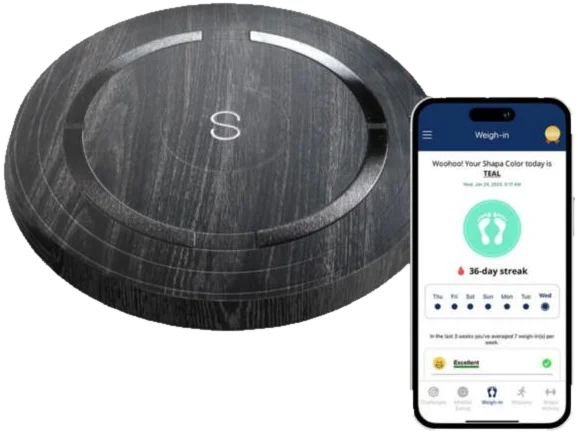
Step on the Numberless Scale each morning and see your trend as a color instead of a number. The Shapa app turns that trend into small daily missions, personalized to you.
- Start the daily check-in now One step on the scale each morning becomes routine, so it’s already in place when your treatment changes.
- See progress when the scale slows Your color shows the direction of your trend, which keeps you going through plateaus as weight loss levels off.
- Practice the habits that last The app’s daily missions are small actions personalized to you, practiced while the medication is helping.
- Bring your trend to appointments Weeks of check-ins give you and your doctor something concrete to discuss when you plan a maintenance dose.
What’s happening in your body
As the medication’s effect fades, hunger signals tend to return and your body pushes back toward its old weight. In the STEP 1 trial extension, adults lost an average of 17.3% of their body weight over 68 weeks on semaglutide. One year after stopping, they had regained 11.6 percentage points, about two-thirds of what they had lost.
STEP 1 extension: one year after stopping semaglutide
Semaglutide group
Placebo group
What Shapa does for you now
Step on the Numberless Scale each morning and see your trend as a color instead of a number. The Shapa app turns that trend into small daily missions, personalized to you.
- Catch drift early A change in your color flags an upward trend while it’s still small and easy to act on.
- Keep the habits you built Your check-in and missions carry on unchanged, so the routine doesn’t end when the prescription does.
- Stay close through the first year In the STEP 1 extension, people regained about two-thirds of their loss in their first year off treatment. That year is when daily check-ins matter most.
- Know when to call your doctor If your trend keeps climbing for several weeks, talk with your doctor about next steps, including whether to restart treatment.
Ask your doctor
- Should I stay on a maintenance dose, and for how long?
- If I reduce or stop, how should we taper, and when should we check in?
- What change in my weight trend should prompt a call?
- How much protein and strength training do I need to protect muscle?
87% of Shapa members use Shapa 5 or more times a week, as reported by Shapa.
Common questions
Will I regain weight if I stop my GLP-1?
Many people do. In the STEP 1 trial extension, people regained about two-thirds of their weight loss within a year of stopping. Results vary from person to person, and a maintenance plan helps you spot drift early.
How can Shapa help after my GLP-1 treatment ends?
Shapa keeps your daily check-in going. One step on the Numberless Scale shows your trend as a color, so an upward drift shows up early, and the app’s daily missions keep your habits going once the medication’s help fades.
Is regaining weight after a GLP-1 a failure?
No. Obesity is a chronic, relapsing disease, and regain reflects biology, not willpower. Treat it as a signal to adjust your plan with your doctor.
Does Shapa replace my medication or my doctor?
No. Shapa supports daily habits alongside the care plan you make with your doctor. It doesn’t prescribe or change medication.
Shapa has a journey for people on, or coming off, GLP-1s
Take the Shapa Assessment to start the journey that matches your situation.
Start Assessment →
Get 70% Off a Lifetime Membership →
Pay once. Never pay again.
Use code PAYONCE at checkout.
HSA/FSA eligible