
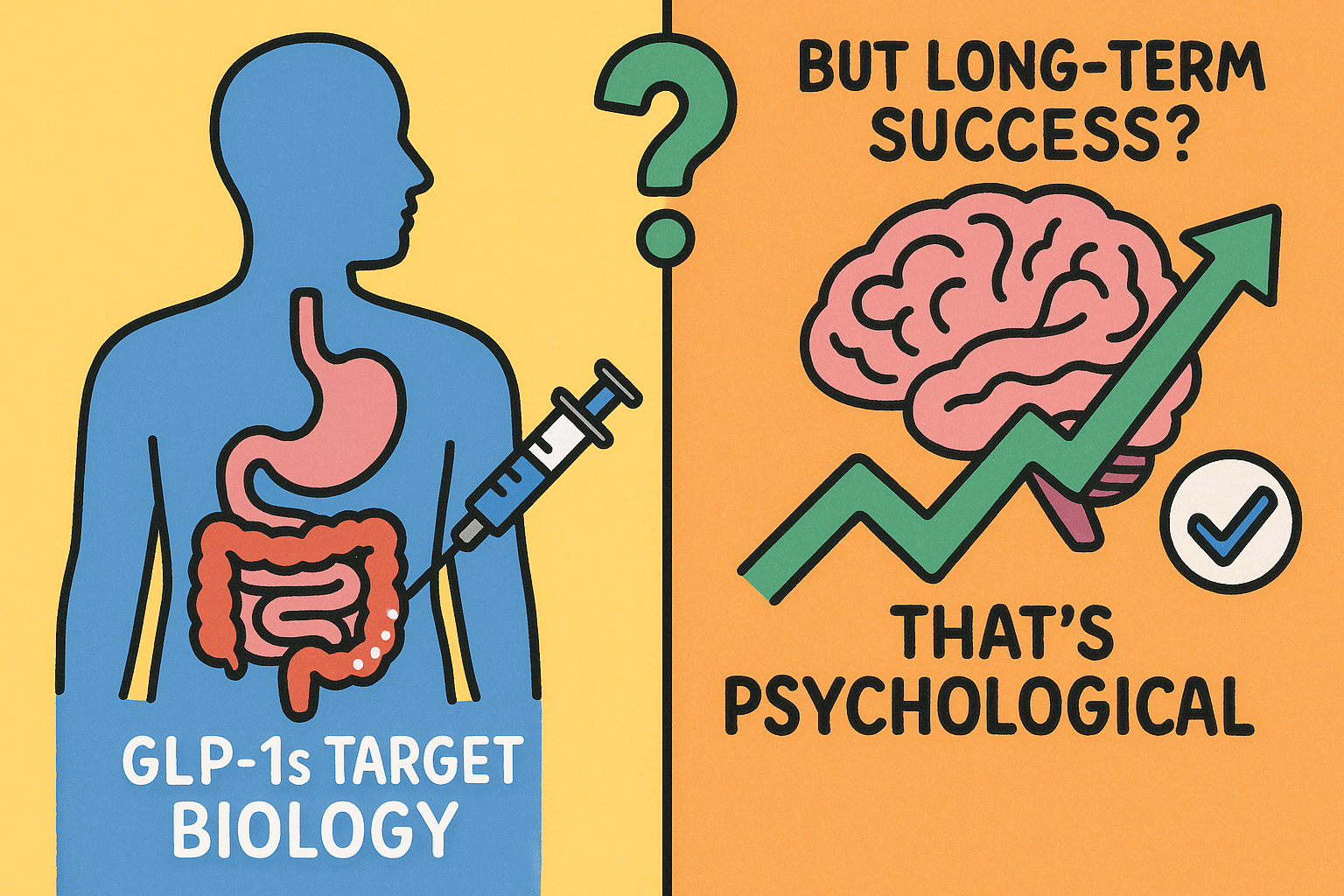
GLP-1s Target Biology. But Long-Term Success? That’s Psychological

We live in a country where 40% of adults are obese, and much of that is not simply because people “lack willpower.” It’s because our biology has been hijacked.
That’s the argument Dr. David A. Kessler makes in his deeply personal and illuminating New York Times opinion piece, “In a World of Addictive Foods, We Need GLP-1s.” As a former FDA commissioner and lifelong struggler with weight, Kessler lays out the hard truth: our food environment is rigged. Ultraformulated foods — not just “ultraprocessed,” but engineered with addictive precision — light up the brain’s reward centers in the same way cigarettes once did.
And the result?
A nation weighed down not only by obesity but by shame, misinformation, and a healthcare system that rarely looks beyond the number on the scale.
And that’s exactly why we need a fundamental shift in how we think about weight, progress, and health.
That’s where Shapa’s Stress-Free Numberless Scale® comes in.
And while the New York Times piece doesn’t mention it, it echoes exactly the kind of psychological liberation Shapa is pioneering. It’s the idea that maybe we don’t need to obsess over daily fluctuations or spiral over a single weigh-in. Maybe what we need is a more human, more real way to engage with our health — especially if we’re going to truly leverage revolutionary treatments like GLP-1s and support long-term change.
A Scale That Speaks to the Brain — Not Just the Belly
Shapa isn’t just a scale.
It’s a paradigm shift.
Instead of flashing a number at you — that often meaningless, emotionally loaded figure — it gives you a color-coded signal based on your long-term trend. It’s not about what your body is doing that day, that moment, before coffee and after a salty dinner. It’s about where your body is heading, and what it’s trying to tell you.
This isn’t just convenient. It’s neuroscience.
Because as Kessler explains in his NYT piece, the real fight isn’t just against fat — it’s against food noise, that relentless internal chatter amplified by ultraformulated foods, stress, trauma, and toxic perfectionism. GLP-1 medications work in part by quieting that noise, dialing down the brain’s obsession with the next dopamine hit. But to sustain any progress — whether from a drug, a diet, or sheer habit — we need tools that rewire how we feel about our bodies.
Shapa does just that. By removing the number, it removes the judgment. It retrains the brain to focus on momentum over micromanagement. And momentum — not punishment — is what keeps people engaged.
GLP-1s Are Powerful. But They’re Not Enough.
As Kessler rightly warns, GLP-1 drugs are not magic.
They come with side effects, dropout rates, and high costs. Many people won’t stay on them for life. That means behavioral change isn’t optional — it’s essential. And yet, most doctors aren’t trained in how to help patients build the habits that keep weight off and shame out of the equation.
So how do we bridge that gap?
We need an ecosystem that reinforces long-term change. That’s where behaviorally intelligent tools like Shapa can play a massive role — quietly, daily, compassionately — in keeping people on track without triggering the anxiety that makes people give up. Whether you’re on GLP-1s or not, seeing your progress visualized in a non-judgmental way helps you stay the course. It builds trust between you and your body.
Why the Number Has to Go
Weight has always been more than a number — it’s been a metaphor for failure, for identity, for control. But in the age of GLP-1s, neuroscience, and personalized medicine, we now know that the scale number is a blunt, outdated instrument.
It’s time to move past it.
When Shapa users step on their scale, they don’t see a number.
They see a signal.
A cue.
A trend.
And that subtle shift has been a game-changer — especially for those who’ve spent years stuck in a cycle of weight loss and shame. Because the truth is, as Dr. Kessler’s article makes heartbreakingly clear: biology is not morality. And no one should feel like a failure for having a body that responds exactly the way it was designed to — especially in an environment designed to keep us hooked.
A Revolution That Needs More Than Pills
We’re standing at a crossroads. On one hand, we have revolutionary medications like GLP-1s that can break the physiological cycle of food addiction. On the other, we have a growing awareness that mental and behavioral tools are just as critical to long-term success. Shapa sits right at the intersection of those two truths — helping people understand their progress without fear, without self-loathing, and without surrendering to the number.
Because the future of health isn’t just chemical. It’s emotional. And it starts with changing how we measure progress.
And sometimes, the best way to move forward is to stop looking down at the scale — and start looking at the bigger picture.
No numbers. No judgment. Just forward.