The Future of Health Starts After Treatment

The next era of health will not be defined by what we can treat. It will be defined by what people can sustain.
There was a time when the highest ambition in healthcare was to return someone to baseline.
Find the problem. Treat it. Stabilize the patient. Send them back into the world.
That achievement still matters enormously. But culturally, economically and technologically, baseline is no longer where the conversation ends.
People do not simply want to avoid being sick. They want to feel strong, clear-headed, rested and metabolically healthy. They want to preserve mobility, protect their cardiovascular health, maintain muscle and have enough energy to participate fully in their own lives.
They are not only thinking about lifespan.
They are thinking about healthspan: how many of those years can be lived with vitality, independence and confidence.
In other words, people no longer want to be told they are “fine.”
Fine is starting to feel like the bare minimum.
We Have Entered the Optimization Era
Healthcare is becoming increasingly consumerized, personalized and continuous.
People are tracking sleep, recovery, heart rate, glucose, movement, nutrition and stress. Peptides have entered the mainstream wellness vocabulary. Strength training has been reframed as an investment in longevity. Consumers are learning about metabolic health, nervous-system regulation, muscle preservation and biological age with a fluency that would have seemed highly specialized only a few years ago.
And then came GLP-1s.
These medications have fundamentally altered the weight-management landscape. They have also forced the broader healthcare industry to reconsider long-held assumptions about obesity, willpower and treatment.
By late 2025, KFF found that 12% of U.S. adults were currently taking a GLP-1 medication for weight loss, diabetes or another chronic condition. Nearly one in five adults reported having used one at some point.
That is not a fringe wellness movement.
It is a structural change in the way millions of people approach their health.
For many, GLP-1 therapy has made meaningful progress feel biologically possible after years of frustration, shame and oversimplified advice. It has opened an important door.
But opening the door is not the same as building a life on the other side of it.
The Treatment Is Not the Transformation
Powerful interventions can change physiology.
They cannot automatically change a person’s environment, routine or relationship with health.
A medication cannot prepare a balanced meal, protect someone’s sleep schedule, build muscle, take a walk or remember to monitor blood pressure. It cannot make the healthier decision easier on a chaotic Wednesday when someone is overworked, underslept and caring for everyone except themselves.
That is not a criticism of medication. It is an acknowledgment of what sustainable health actually requires.
The World Health Organization now positions GLP-1 therapies as part of comprehensive, long-term obesity care that also includes behavioral support, healthy eating, physical activity and continued follow-up. In other words, medication can be transformative, but it works within a larger system of care.
This distinction will define the next chapter of the wellness and healthcare industries.
The first wave of innovation gave people more interventions.
The next wave must help people integrate those interventions into daily life.
Because the future of health will not be won by the company that produces the most data, the most features or the loudest promises.
It will be won by the systems that help people convert insight into action.
The Real Opportunity Is Behavioral Infrastructure
The wellness industry loves transformation.
Transformation is dramatic. It photographs well. It gives us the before, the after and the triumphant middle.
But long-term health is rarely built in a dramatic moment.
It is built through repetition.
It is taking the reading. Stepping on the scale. Choosing the walk. Drinking the water. Eating the protein. Going to bed. Returning to the routine after a difficult week without declaring the entire effort a failure.
These actions are almost painfully ordinary.
They are also the infrastructure of health.
A 2024 systematic review of health-related habit formation found that habits may begin to form after roughly two months, but the timeline varies substantially by person and behavior. Sustainable change does not arrive on a universal 21-day schedule. It is built through consistency, supportive environments and repeated cues over time.
This is where many health products fail.
They assume that providing information is the same as changing behavior.
It is not.
Most people already know that movement, nutrition, sleep and cardiovascular health matter. The challenge is not a universal information deficit. The challenge is building enough psychological safety, simplicity and momentum for those actions to become repeatable.
What people need is not another dashboard demanding their attention.
They need better behavioral architecture.
They need tools that reduce friction, interpret complexity and make the next decision feel manageable.
More Data Is Not Always More Clarity
We have become extraordinarily good at measuring ourselves.
We can track calories, steps, sleep cycles, heart rate, weight, glucose, blood pressure, recovery and dozens of additional biomarkers.
Yet measurement alone does not create agency.
Sometimes it creates anxiety.
Consider the traditional scale.
A person steps on it after doing everything “right” and sees a higher number because of hydration, sodium, hormones, digestion or the normal volatility of the human body.
The person may intellectually understand that weight fluctuates.
Emotionally, however, the number can still feel like a verdict.
One data point can erase the psychological value of several weeks of progress. The tool that was supposed to create accountability instead creates discouragement, disengagement or avoidance.
This is not a data problem.
It is a design problem.
Health information must be accurate, but it must also be behaviorally legible. It needs to tell people something useful without asking them to surrender their mood, motivation or self-worth to a single number.
That is the philosophy behind Shapa.
Shapa Turns Measurement Into Momentum
Shapa’s Numberless Scale® was designed around a deceptively simple idea:
People need feedback, but they do not always need to see every number.
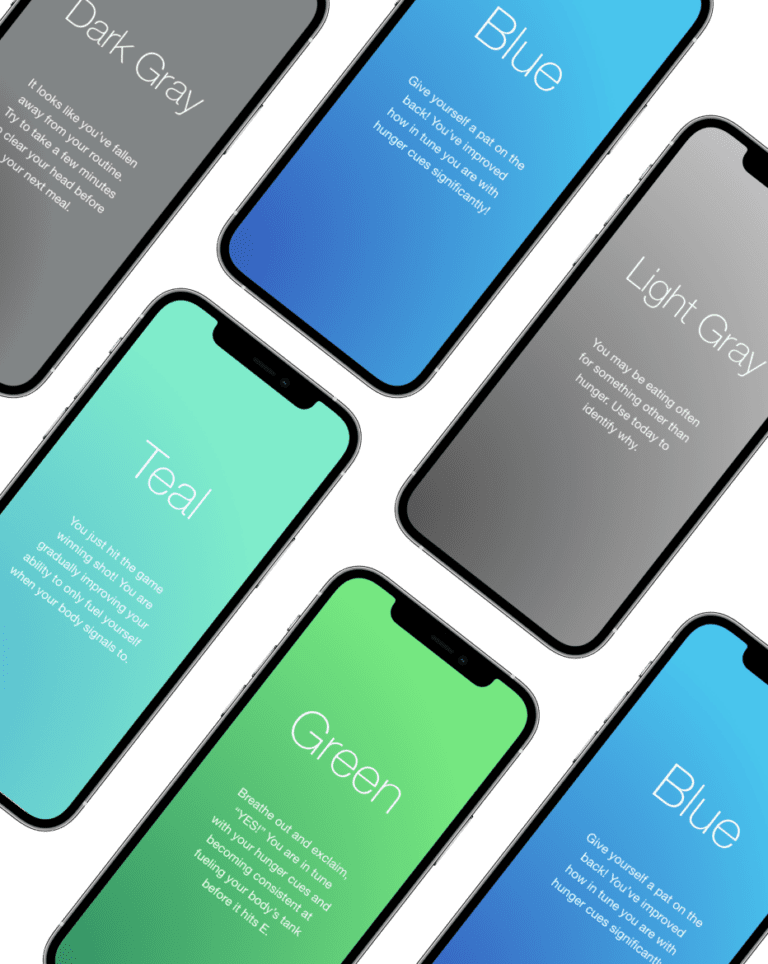
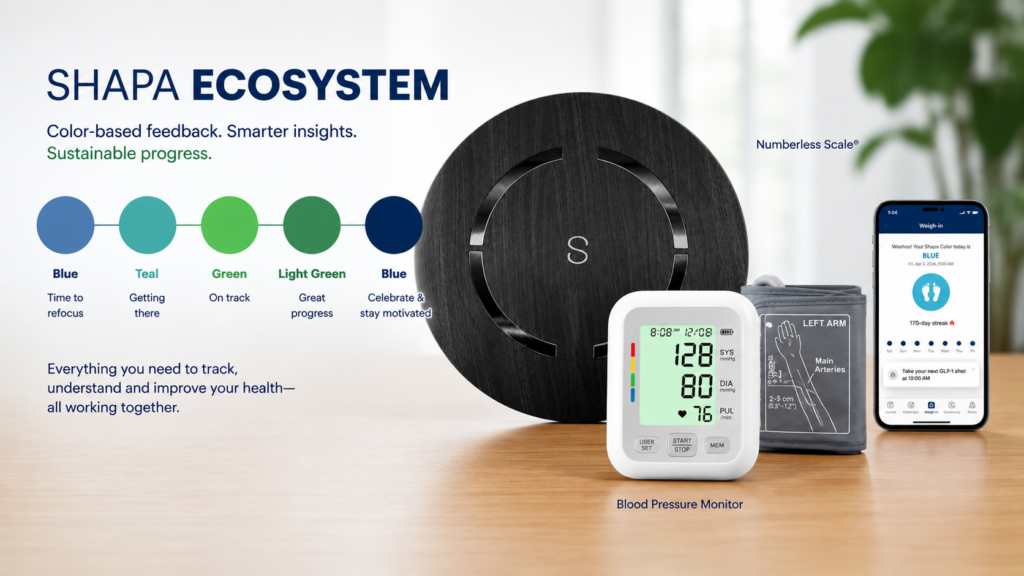
Instead of presenting a daily weight that can be distorted by ordinary fluctuations, Shapa uses a five-color system to show how a person’s recent weight trajectory compares with their three-week norm.
The system focuses attention on direction rather than daily volatility.
Shapa recommends that members step on the scale at approximately the same time each morning. Over time, the act becomes a ritual: step on, receive color-based feedback, reflect and continue.
The color communicates progress without turning the morning into a performance review.
Shapa’s personalized missions then help translate that feedback into approachable actions based on the individual’s habits, personality and lifestyle. The goal is not to prescribe an entirely new identity overnight. It is to introduce changes that can realistically coexist with someone’s actual life.
That difference matters.
Traditional weight-management products often begin by demanding vigilance.
Shapa begins by building engagement.
And engagement is the prerequisite for almost everything that follows.
Optimization Must Look Beyond Weight
The next generation of health platforms cannot reduce wellness to a single metric.
Weight can be relevant, but it is not the entire story.
A person can experience weight loss while overlooking strength, nutrition, sleep or cardiovascular health. Another person may appear outwardly healthy while living with a risk factor they cannot see or feel.
High blood pressure is a particularly important example.
Nearly half of U.S. adults have high blood pressure, according to the CDC. It frequently has no clear warning signs, and measuring it is the only way to know whether it is elevated.
That is why Shapa’s blood-pressure component is not simply an adjacent device.
It expands the ecosystem.
By bringing weight trends, blood-pressure monitoring and personalized behavioral guidance into a more connected experience, Shapa helps people engage with health as a system rather than a collection of disconnected numbers.
This is the direction healthcare must move: away from episodic intervention and toward continuous, comprehensible feedback.
The purpose is not to make people obsess over more measurements.
It is to make important measurements easier to understand and easier to act on.
The American Heart Association supports home blood-pressure monitoring and recommends using an automatic upper-arm monitor, while emphasizing that home monitoring should complement, not replace, professional care.
That last point is important.
Optimization is not about replacing clinicians with gadgets or turning every consumer into their own physician.
It is about giving people better visibility into their health between appointments, when most of life actually happens.
The Future Is Multimodal
The health industry has historically separated treatment, tracking and behavior change into different products, providers and experiences.
The consumer is left to connect them.
A prescription may live in one system. Weight data may live in another. Blood-pressure readings may sit in a notebook. Exercise may be tracked in an app. Nutrition advice may come from social media. The individual is then expected to synthesize all of it while managing work, family, finances and ordinary life.
That fragmentation is not simply inconvenient.
It is a barrier to adherence.
The next era of health will be multimodal. It will combine clinical intervention, biometric visibility, personalized guidance and behavioral reinforcement in ways that feel cohesive rather than burdensome.
Shapa represents this shift.
It is not attempting to compete with medication, clinicians or exercise.
It helps connect those efforts.
For someone beginning GLP-1 therapy, Shapa can help create a daily foundation around the treatment.
For someone currently using a GLP-1, it can help keep attention on broader patterns and repeatable behaviors rather than weight volatility alone.
For someone preparing to transition away from medication under medical guidance, it can help preserve the routines and awareness that support long-term health.
And for someone pursuing health without medication, the same system can provide structure, feedback and accountability without the punitive mechanics of a conventional scale.
This is what a true ecosystem should do.
It should meet people at different points in the journey without treating health as a one-size-fits-all experience.
Optimization Without Humanity Is Just Surveillance
There is a potential danger in the optimization movement.
In our pursuit of better health, we can turn life into an endless evaluation.
Every meal becomes a score. Every night of sleep becomes a grade. Every workout becomes evidence of discipline or failure. Every biometric becomes another reason to believe we are falling behind.
That is not health.
That is surveillance disguised as self-improvement.
The best health technology will not ask people to monitor themselves more aggressively.
It will help them understand themselves more compassionately.
That requires a different design philosophy: less shame, less volatility, less cognitive overload and more context.
Shapa’s numberless, color-based approach matters because it does not eliminate accountability.
It makes accountability more sustainable.
It recognizes that psychological experience is not separate from health behavior. It is one of the strongest forces shaping whether that behavior continues.
Being “Cured” Is Only the Beginning
Calling being cured “the bare minimum” is intentionally provocative.
A cure, when one exists, is extraordinary. Stabilizing a chronic condition can be life-changing. Effective treatment should never be minimized.
But the underlying idea remains important:
People increasingly expect more from health than the absence of immediate illness.
They want to thrive.
They want to feel capable in their bodies. They want cardiovascular resilience, metabolic strength, emotional stability, restorative sleep and the energy to participate in their relationships and ambitions.
They want tools that help them understand progress without making them afraid of it.
This is not vanity.
It is the maturation of the modern health consumer.
The industry’s responsibility is to meet that ambition with more than optimization theater, miracle language or an endless supply of expensive interventions.
It must provide systems that support real behavior.
The Companies That Lead Will Close the Gap
The defining gap in healthcare is no longer only the distance between sickness and treatment.
It is the distance between treatment and sustained well-being.
GLP-1s can change the biological conditions surrounding weight management. Clinicians can diagnose, prescribe and guide. Exercise can build strength. Nutrition can support health. Monitoring can reveal patterns.
But people still need a way to connect those pieces in daily life.
That is where Shapa has the opportunity to lead.
Not as another device.
Not as another set of numbers.
As the behavioral operating system that helps make modern health tools more usable, more humane and more sustainable.
The future will not belong to products that simply tell people what happened.
It will belong to platforms that help people decide what to do next.
Because being okay may be where healthcare once stopped.
Today, it is where optimization begins.
Sources
- KFF Health Tracking Poll: Current and historic use of GLP-1 medications among U.S. adults, November 2025.
- World Health Organization: Global guidance on GLP-1 therapies as one component of comprehensive, long-term obesity care, December 2025.
- Centers for Disease Control and Prevention: High-blood-pressure prevalence, risks and the importance of regular measurement, updated 2026.
- American Heart Association: Guidance on home blood-pressure monitoring and understanding readings, updated 2025.
- Singh et al., Healthcare: “Time to Form a Habit: A Systematic Review and Meta-Analysis of Health Behaviour Habit Formation and Its Determinants,” 2024.
- Shapa: Product methodology, five-color feedback system, three-week norm, daily measurement ritual and personalized missions.