Consistency Beats Intensity. Science Finally Explains Why


There is a persistent misconception at the center of weight loss.
That success is a function of effort.
That failure reflects a lack of discipline.
This framing is convenient. It is also wrong.
What behavioral science has shown, repeatedly, is that adherence is not primarily a willpower problem. It is a systems problem. Specifically, a problem of how actions are structured and how outcomes are interpreted.
The Limits of Traditional Feedback
Most weight loss tools rely on a simple loop:
Do something → measure result → adjust
In theory, this is rational. In practice, it breaks down almost immediately.
Daily weight is a volatile signal. It is influenced by hydration, sodium intake, glycogen storage, hormonal variation, sleep, and timing. Fat loss is slow; noise is fast.
Yet users are asked to interpret each measurement as meaningful.
The result is a predictable cognitive error: short-term fluctuation is mistaken for trend. Progress feels inconsistent, even when it is not. Motivation becomes reactive, and therefore unstable.
What the Evidence Actually Supports
A recent randomized clinical trial published in JAMA Network Open offers a more precise understanding of how behavior change begins.
Rather than prescribing large, comprehensive changes, the study tested “microsteps”; small, concrete actions delivered digitally. These included modest interventions such as brief movement, incremental dietary adjustments, and simple stress management behaviors.
The findings are notable for their consistency:
- Participants showed significant increases in behavioral expectation, a stronger predictor of action than intention
- Effects were observed immediately after exposure and persisted, though attenuated, at two weeks
- Emotionally resonant delivery improved uptake compared with purely instructional formats
Two conclusions follow.
First, behavior change is more likely when the required action is perceived as achievable within existing constraints.
Second, even effective interventions degrade without reinforcement.
The implication is straightforward: small actions work, but only within a system that sustains them.
From Intervention to System
Most health tools stop at intervention. They suggest what to do, but they do not adequately manage what happens next.
This is where the distinction between guidance and system design becomes critical.
Shapa approaches the problem as a closed behavioral loop rather than a set of isolated recommendations.
1. Action is constrained and simplified
Shapa “missions” operate on the same principle validated in the clinical literature: reduce behavioral change to discrete, low-friction actions.
These are intentionally modest:
- Adjust a single dietary choice
- Introduce a short period of movement
- Modify a small aspect of daily routine
The objective is not immediate transformation. It is repeated execution.
2. Context is incorporated
Prior to delivering guidance, Shapa gathers information about the user’s habits, environment, and behavioral tendencies.
This is not personalization as a feature. It is a requirement for efficacy.
Behavioral interventions are context-dependent. An action that is trivial for one individual may be prohibitive for another. Aligning recommendations with existing constraints increases the probability of adoption.
3. Feedback is re-engineered
The most consequential difference lies in how outcomes are presented.
Traditional scales expose users to raw numerical data, despite the fact that short-term weight is a poor proxy for underlying progress.
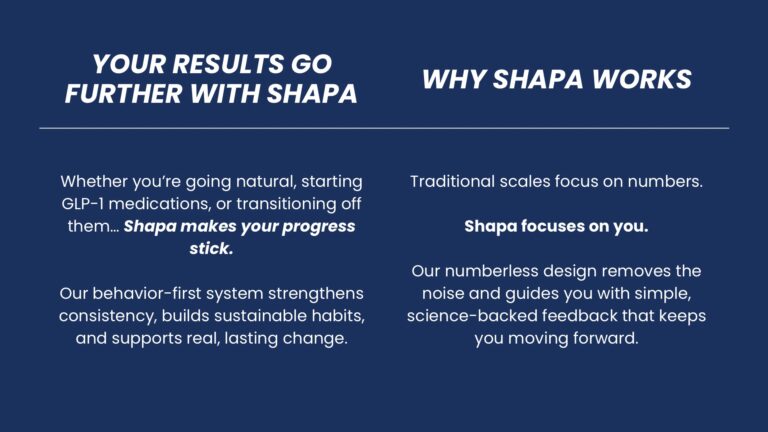
Shapa replaces this with a trend-based system. Daily measurements are aggregated, and progress is communicated through categorical feedback rather than precise numbers.
This is not a simplification for its own sake. It is a correction.
By filtering out short-term variance, the system reduces misinterpretation. Users are less likely to react to noise and more likely to maintain consistent behavior.
Closing the Behavioral Loop
The combined effect is a more stable feedback cycle:
Small action → filtered feedback → accurate interpretation → continued action
Each component addresses a known failure point:
- Actions are achievable, increasing initial uptake
- Guidance is personalized, improving relevance
- Feedback is stabilized, preserving motivation
The clinical evidence supports the first element. The necessity of the remaining elements follows from the observed decay in effect over time.
Without reinforcement, behavior change diminishes. Without accurate feedback, reinforcement becomes unreliable.
A More Accurate Model of Change
What emerges from both the research and its application is a different model of weight loss.
Not one based on intensity or precision, but on:
- Feasibility over ambition
- Consistency over variability
- Signal clarity over data abundance
This model does not eliminate effort. It reallocates it.
From attempting to control outcomes directly, to maintaining a system in which outcomes emerge predictably.
From Intervention to Sustained Change
The question is not whether people are capable of change.
The evidence suggests they are, under the right conditions.
Small, well-designed actions can initiate that change.
But initiation is insufficient.
Sustained progress requires a system that reinforces behavior and presents outcomes in a way that reflects reality rather than noise.
That is the gap between intervention and adherence.
And it is where most approaches fail.