
No More Number Panic: How Shapa Redefines the Weigh-In Experience

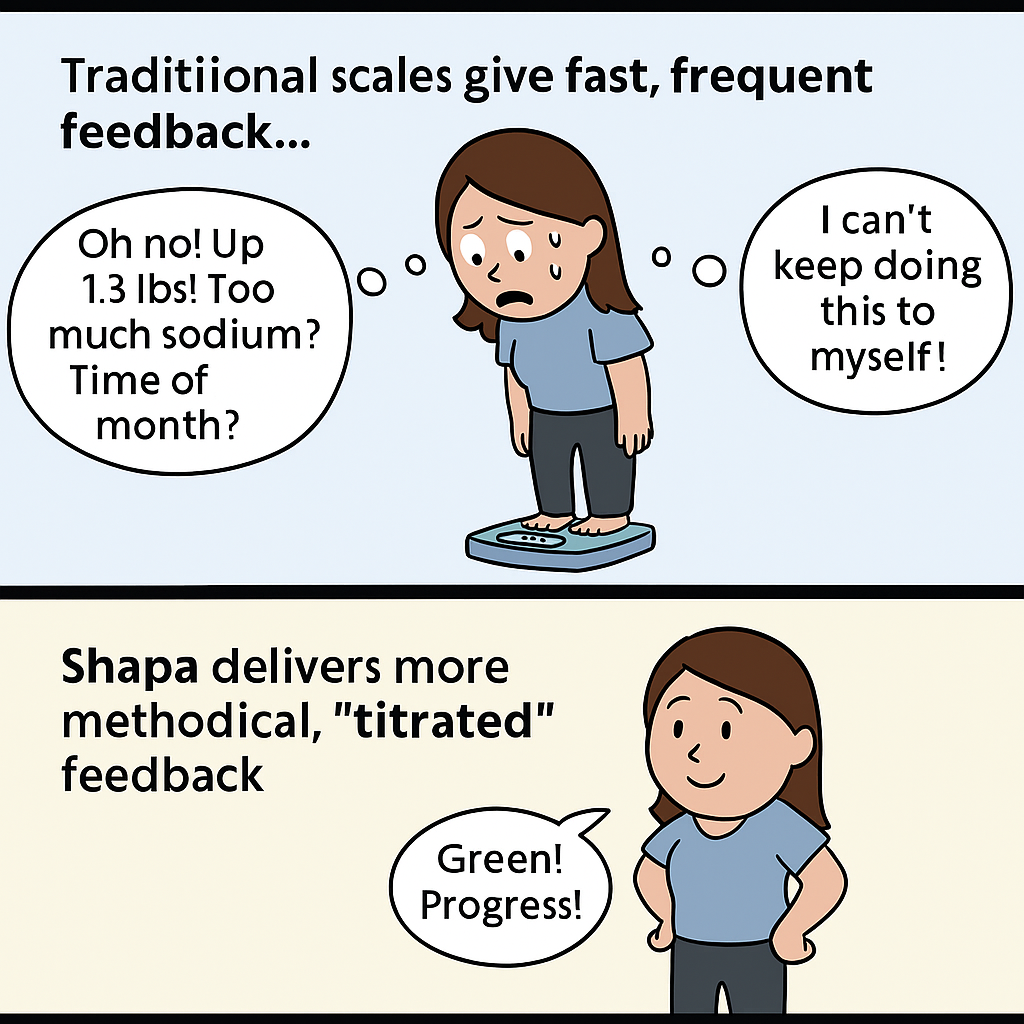
For decades, the standard bathroom scale has been seen as a necessary tool for weight management. But for millions, it’s become a daily source of anxiety—offering hyper-detailed data without context, overwhelming users with fluctuations that often reflect water retention or sodium intake more than meaningful change.
The result? A feedback loop that drives stress instead of action.
Shapa was built to solve this—and it does so through a behavioral science principle rarely applied in consumer health: titration.
The Problem: Feedback That’s Too Fast, Too Frequent, and Too Emotional
Research consistently shows that daily self-weighing can support weight loss and weight maintenance, but only when framed appropriately. A 2024 review published in Current Cardiovascular Risk Reports found that individuals who weighed themselves daily experienced greater success in managing their weight compared to those who did so less frequently or not at all. However, the benefits were most pronounced when daily weighing was combined with clear, structured, and psychologically supportive feedback.
This is where traditional bathroom scales often fall short.
They deliver raw numbers without nuance. One day you’re up 1.3 pounds—no explanation, no context. It could be hormonal shifts, a salty dinner, or a tough workout leaving you inflamed. But to the user, it just feels like failure. Over time, that kind of feedback doesn’t inspire progress—it erodes motivation and reinforces all-or-nothing thinking.
The Shapa Solution: Titrated Feedback, Calibrated Over Time
Shapa removes the number entirely.
Instead of displaying weight, it uses a color-based feedback system that communicates meaningful trends—green for progress, blue for stability, gray for areas that may need attention.
But this feedback isn’t delivered immediately. For the first 10 days, Shapa collects data silently. This initial “calibration phase” allows the system to establish a personalized baseline, accounting for each user’s natural fluctuations. It’s a deliberate, methodical approach—what behavioral scientists would call a titration model.
Titration: A Behavioral Science Principle Applied to Health Feedback
In scientific terms, titration refers to gradually adding a substance to reach a precise reaction point. It’s used in medicine, chemistry, and psychology—where precision matters more than speed.
Shapa applies this same principle to behavioral feedback:
- Data is collected consistently (users are encouraged to weigh in daily)
- Immediate reaction is withheld (no number displayed)
- Insight is only provided when the system has enough information to confidently detect a trend
This reduces noise, prevents overreaction, and creates space for long-term habit formation.
The Behavioral Impact: Less Cognitive Load, More Adherence
By reducing the emotional volatility of daily weighing, Shapa addresses one of the most underappreciated barriers to sustained behavior change: cognitive overload.
Studies from Stanford’s Behavior Design Lab and BJ Fogg’s work suggest that simplicity and consistency are the biggest predictors of adherence. When people don’t have to interpret or emotionally process volatile data every day, they’re more likely to stay engaged with the process—and ultimately, achieve their goals.
In Shapa’s own internal research:
- Users who engaged with the device daily, even without seeing numbers, showed increased consistency in daily healthy habits.
- A majority reported reduced anxiety around weight, and greater focus on lifestyle behaviors like meal planning, physical activity, and hydration.
Why This Matters: A New Model for Digital Health Feedback
As health technology evolves, the quality and delivery of feedback are emerging as just as important as the data itself. Whether in glucose monitoring, sleep tracking, or weight management, systems that offer titrated, personalized feedback are showing stronger long-term engagement and lower user fatigue.
Shapa exemplifies this approach.
It doesn’t withhold information—it refines it.
It doesn’t eliminate accountability—it reframes it.
And it doesn’t assume every user is a data scientist—it respects that humans need support, not just stats.
Progress Isn’t a Number. It’s a Pattern.
In the end, Shapa’s radical act isn’t what it removes—it’s what it restores: a sense of control.
By applying titration to feedback delivery, Shapa helps users stay focused on patterns over points, habits over highs and lows, and progress over perfection.
It’s not just a smarter scale.
It’s a more human approach to behavior change.